The Real Difference Between Cheap and Expensive Pilates Reformers: A Manufacturer’s Breakdown
For studio owners and B2B fitness distributors, outfitting a commercial space is a major capital investment. When you compare equipment online, you will often find machines that look identical in photos but have price tags that vary by thousands of dollars.
So, what is the actual difference between cheap and expensive Pilates reformers?
As a direct manufacturer of premium commercial Pilates equipment, we know exactly where corners are cut to lower prices. The true difference lies entirely in the engineering: the raw materials, the wall thickness, and the internal components. Here is our definitive breakdown.
1. Frame Material & Wall Thickness (The Skeleton)
The frame dictates the machine's lifespan and its ability to absorb vibration during dynamic movements. This is the most expensive part to manufacture, and therefore, the first place cheap brands cut costs.
-
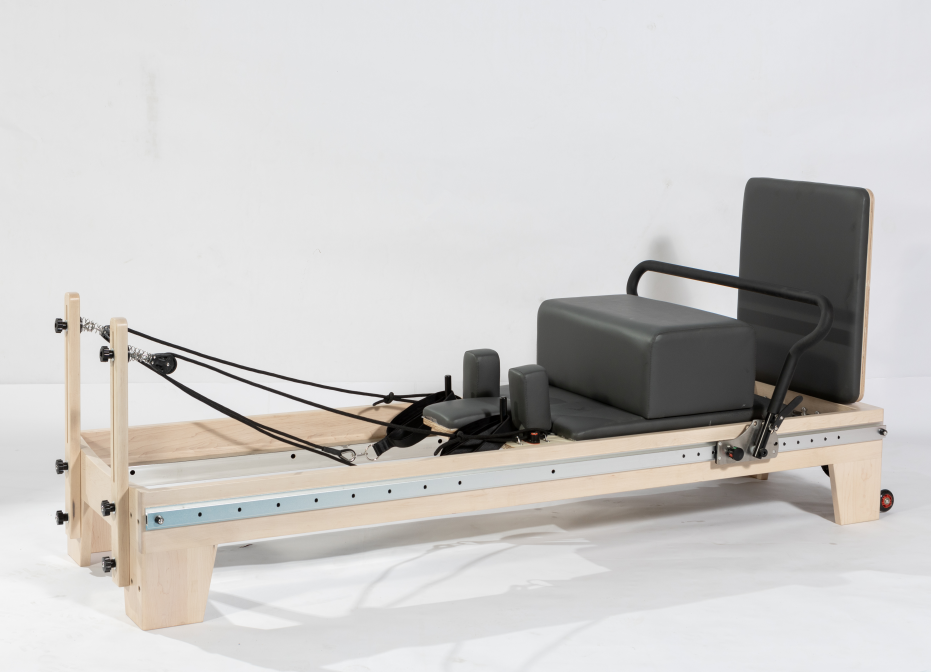
Cheap Reformers: Budget machines often use thin-walled steel or cheap aluminum extrusions (sometimes less than 1mm thick). For wooden models, they use hollow MDF (Medium Density Fiberboard) or plywood covered with a wood-grain sticker. Under heavy weight or intense jumping, these thin frames will sway, bend, and eventually crack.
-
Expensive / Commercial Reformers: Premium machines are over-engineered. Our commercial wood reformers utilize 28mm to 35mm thick Solid Maple or Oak. This extreme density absorbs all shock and vibration. For metal models, premium manufacturers use heavy-duty die-cast aluminum or utilize 3.5mm wall-thickness 304 stainless steel for Cadillac canopies, guaranteeing absolute zero flex during aerial suspension work.
2. Track & Glide Mechanics (The Ride)
Your clients judge a Pilates class by the smoothness of the carriage. A noisy, grinding carriage instantly ruins the premium feel of a studio.
-
Cheap Reformers: Budget models use generic plastic wheels riding on thin, unhardened aluminum tracks. Over a few months, the plastic wheels wear down unevenly, and the tracks develop deep grooves, resulting in a bumpy, loud, and frictionless ride.
-
Expensive / Commercial Reformers: High-end machines utilize a precision 8-wheel or 10-wheel system. This involves vertical high-elastic load-bearing wheels paired with horizontal auxiliary wheels to grip the sides. Crucially, they ride on 1.5mm to 2mm thick stainless steel tracks. This combination ensures a whisper-quiet, frictionless glide that lasts for years without grooving.
3. The Spring System (The Engine)
Springs are the heart of Pilates. They provide the necessary resistance for strength building and the support for clinical rehabilitation.
-
Cheap Reformers: Low-cost machines use standard, untreated carbon steel springs. After just a few hundred stretch cycles, these springs suffer from "metal fatigue." They lose their tension, stretch out unevenly, and pose a severe safety hazard as they can snap under pressure.
-
Expensive / Commercial Reformers: Premium reformers rely on fatigue-tested, imported Korean or German springs. These are crafted from specialized high-carbon steel alloys and undergo rigorous factory calibration. They deliver a perfectly linear stretch and maintain their precise tension (e.g., Heavy - 28kg) cycle after cycle, typically backed by a multi-year warranty.
4. Upholstery & Padding Density (The Touchpoints)
The areas where the client's body contacts the machine (carriage, headrest, shoulder blocks) take a massive amount of abuse from sweat, friction, and localized pressure.
-
Cheap Reformers: Budget options use thin PVC leather that cracks easily. More dangerously, they use "recycled cotton" or low-density sponge for padding. Within months, the padding compresses permanently, leaving clients kneeling directly on the hard wooden carriage board underneath.
-
Expensive / Commercial Reformers: Commercial-grade equipment uses 1mm to 1.2mm tear-resistant Microfiber Leather, which is entirely sweat-proof and easy to sanitize. Underneath, premium manufacturers use high-resilience EVA foam or high-density virgin sponge. This material offers firm joint support and springs back to its original shape instantly, even after years of heavy daily use.
5. Country of Origin & Component Sourcing (The Global Supply Chain)
When discussing the difference between cheap and expensive Pilates reformers, we must look at where they are built and where their components come from.
-
Cheap Reformers: Budget machines are often mass-produced in low-tier assembly lines that focus strictly on volume and price-cutting. They use 100% domestic, untested domestic components to keep the final price at rock bottom, sacrificing international clinical standards.
-
Expensive / Commercial Reformers (The Korean & Global Standard): Countries with booming, highly advanced Pilates markets—such as South Korea—have established strict clinical standards for equipment. Many expensive, top-tier global brands utilize a hybrid supply chain: they source their heavy structural frames (wood and die-cast aluminum) from premium, high-tech manufacturing hubs in China, while importing precision components like Korean or German springs.
As a premium China manufacturer, we adopt this exact global standard. We utilize China's advanced CNC machining and raw material dominance for the frames, and pair them with imported Korean springs, delivering top-tier global quality without the geographical markup.
6. Brand Premium vs. Factory Direct (The Hidden Markup)
Finally, the most significant price gap often has nothing to do with the materials at all. It comes down to the logo on the machine.
-
The "Expensive" Brand Markup: When you buy an expensive reformer from a famous international brand, you are not just paying for solid wood and stainless steel. You are paying a massive premium (often 40% to 60%) to cover their global marketing campaigns, celebrity endorsements, warehouse storage, and middleman distributor commissions.
-
The "Cheap" Unbranded Risk: Conversely, buying the cheapest unbranded machine online means you have zero after-sales support, zero warranty, and zero accountability when the machine breaks.
-
The Manufacturer's Sweet Spot (OEM): The smartest B2B buyers—including top studios and regional distributors—understand this secret. By purchasing directly from a high-end commercial manufacturer in China, you get the exact same engineering, the same 28mm solid wood, and the same imported springs as the "expensive" brands. The only difference? You skip the brand markup. Plus, factories allow you to utilize OEM services (like free laser-engraved logos) to build the value of your own brand, rather than paying for someone else's.
The Bottom Line: Protecting Your Business
Understanding the difference between cheap and expensive Pilates reformers comes down to recognizing the hidden costs. A cheap machine may save you money upfront, but it will cost you clients, constant repair fees, and ultimately require a full replacement within a year or two.
An expensive, commercial-grade machine is an investment that protects your studio's reputation and delivers a flawless user experience for a decade.
Bypass the Markup, Not the Quality
You don't have to overpay retail prices to get premium thickness and high-end materials. By sourcing your equipment directly from our manufacturing facility, you bypass the middleman and secure true commercial-grade construction—from 28mm solid wood to German springs—at competitive factory-direct pricing.
Ready to equip your studio with machinery built to last? Contact our B2B export team today to request a detailed specification sheet and a custom wholesale quote!
The Difference Between Pilates Reformer and Cadillac: A B2B Buyer's Guide
The Ultimate Guide: What to Look for When Buying a Pilates Reformer
Related Article